



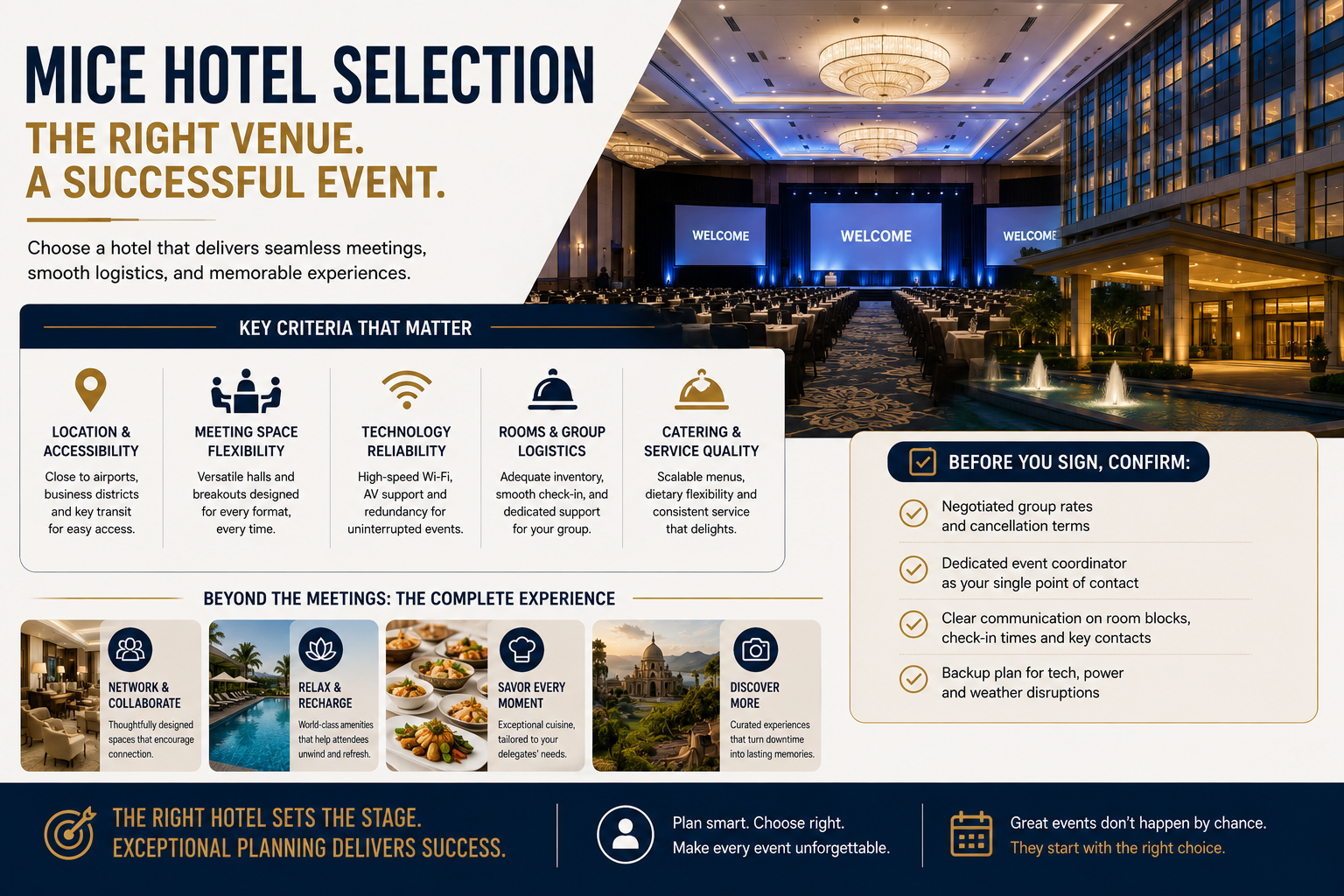
MICE hotel selection comes down to matching a property's location, meeting infrastructure, and service depth to what your event actually needs on the day it happens. It sounds simple until you're the one comparing five proposals, each promising "world-class facilities" and "seamless execution," with no easy way to tell which one will actually hold up when three hundred delegates walk in at nine on a Monday morning.
This is where most corporate teams get stuck. HR and admin staff are often handed event logistics on top of their regular workload, with limited time to visit properties in person or read between the lines of a sales pitch. A wrong call doesn't just mean an awkward seating arrangement, it can mean a stalled Wi-Fi connection during a keynote, a catering shortfall halfway through lunch, or delegates arriving late because nobody checked the route from the airport.
In this blog, we'll walk through the criteria that actually separate a good MICE venue from a merely adequate one.
domain Essential Venue Selection Checklist
Evaluate meeting space acoustics, Wi-Fi redundancy, group check-in workflows, and catering scalability before signing any hotel contract.
Why MICE Hotel Selection Deserves More Than a Quick Google Search
A conference venue is one of the first things attendees experience, and it shapes their impression of your organization before a single presentation begins. A well-run property with attentive staff signals that your company pays attention to detail, while a disorganized one reflects poorly regardless of how good the content on stage is.
It also affects how the day actually functions. Venues that are easy to reach, clearly signposted, and equipped with a capable on-site team reduce the small frictions that eat into your schedule, late arrivals, confused delegates, last-minute room changes. None of this shows up on a brochure, but it's exactly what determines whether your event feels effortless or chaotic.
Start With Location and Accessibility
Before comparing meeting rooms or menus, look at how easily your attendees can actually get there. Proximity to the airport or major transit hubs matters enormously for multi-city or international attendees, and a property within a short drive of the city center tends to work better for local delegates juggling other commitments.
Among business event hotels, the ones that consistently perform well are those situated in established commercial districts, close enough to restaurants, banking, and transport that delegates aren't stranded once the sessions end. If your event spans several days, this also affects how attendees spend their evenings, and by extension, how energized they are the next morning.
Evaluate the Meeting Space Itself
Once location is settled, the meeting space is where most of the real evaluation happens. You're not just booking a room, you're booking a container for your entire agenda, and it needs to flex across formats without feeling like a compromise.
Plenary or Main Halls
Ceiling height, acoustics, and sightlines matter more than square footage alone. Column-free layouts handle keynotes and awards seamlessly.
Breakout Rooms
Workshops need spaces close to the main hall, running simultaneously without sound bleeding between walls.
Exhibition Space
Dedicated networking and display areas built for foot traffic without requiring room re-setups between sessions.
What's Your Backup Plan If the Tech Fails?
This question rarely gets asked until something breaks, and by then it's too late. A serious MICE property should be able to tell you upfront what redundancy exists for Wi-Fi, whether they support hybrid streaming, and who handles live troubleshooting during your event rather than after it.
Ask for a technical walkthrough before you sign anything, not just a features list. Reliable AV support, fast internet, and a technician on standby aren't nice extras, they're the difference between a session that runs on schedule and one that stalls in front of your entire audience.
Don't Overlook Room Inventory and Group Logistics
Conference hotel booking gets complicated fast once you're managing dozens or hundreds of rooms rather than a handful. You'll want a mix of standard rooms for general attendees and a few executive options for speakers or VIP guests, along with a group check-in process that avoids long queues at the lobby.
Before Finalizing, Confirm with Shortlisted Hotels:
- check_circle Negotiated group rates and cancellation flexibility
- check_circle A dedicated event coordinator as a single point of contact
- check_circle Clear communication of room blocks, check-in times, and emergency contacts
How Do You Compare Catering and Service Quality Across Hotels?
Catering is one of the easiest things to underestimate and one of the fastest ways to derail delegate satisfaction. Rather than judging on menu variety alone, ask how the hotel handles dietary requirements at scale, how quickly they can adjust numbers if attendance shifts, and whether coffee breaks are timed to your actual schedule rather than a generic template.
Service quality is harder to measure from a proposal, so it helps to ask for references from past corporate clients or, where possible, attend an event they're currently hosting. A hotel that treats your event as a collaborative partnership, not just a room rental, tends to show it in these smaller operational details.
Factor In the Incentive and Downtime Experience
Conferences aren't purely transactional, and the time between sessions matters more than organizers sometimes plan for. A property with genuine networking spaces, decent leisure facilities, or nearby experiences gives attendees somewhere to recharge, which pays off directly in energy and engagement during the next session.
This is particularly relevant for incentive-linked events, where the destination and downtime experience are often as important to attendees as the meetings themselves.
Conclusion
Getting MICE hotel selection right means looking well beyond room rates and glossy photos, weighing location, meeting infrastructure, technology reliability, catering flexibility, and service depth together rather than in isolation. Each of these pieces affects the others, and a property that's strong in one area but weak in another can still leave your event feeling disjointed.
For teams juggling this alongside their regular responsibilities, working with a partner who handles end-to-end MICE logistics, from venue shortlisting to on-ground coordination, often turns what feels like an overwhelming checklist into a straightforward decision. The right hotel doesn't just host your event, it quietly makes sure nothing gets in the way of it.
Written by Shaji
Corporate Travel & MICE Specialist
Expert in corporate travel management, group MICE logistics, and VIP hospitality services for international delegations at Aster Travel.
Need Help Curation & Shortlisting MICE Hotels?
Aster Travel provides end-to-end venue shortlisting, group rates negotiation, and on-ground MICE coordination.